
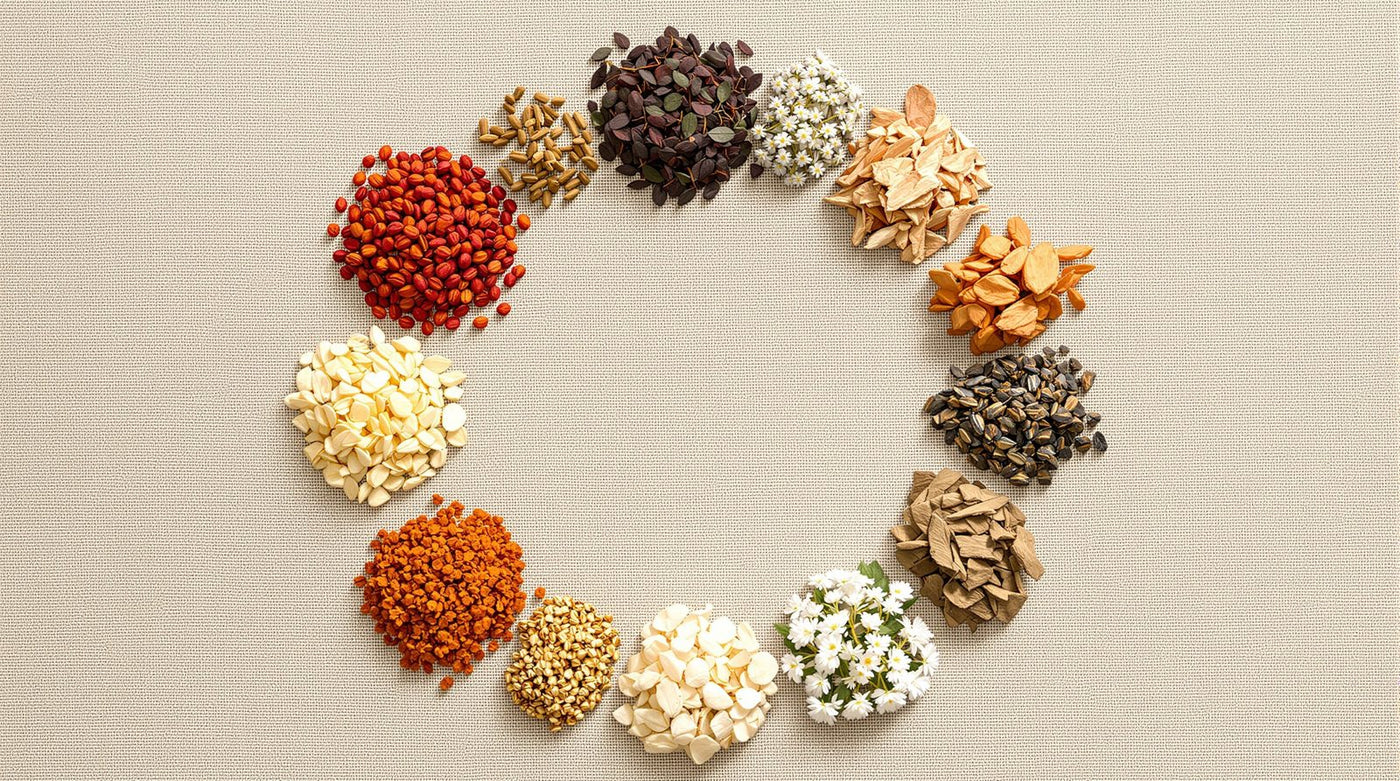
Project: Life formulations draw on 12 clinic grade TCM herbs, each selected for a specific role in reproductive health. Some herbs tonify Blood and Yin to support egg quality. Others warm Kidney Yang to promote ovarian function. Several move Blood to improve uterine circulation. No single herb does all of this. The combination, refined over 40 years of clinical practice by Dr. Ye, is what makes the protocol work.
- Why TCM uses herb combinations rather than single ingredients
- What each of the 12 clinic grade herbs does for fertility
- The two TCM patterns that explain most fertility challenges
- What the clinical research shows
- Can TCM herbs support fertility alongside IVF?
- How long does it take for TCM herbs to work?
- How is a formulation matched to your reproductive profile?
Why do TCM practitioners use herb combinations rather than single ingredients?
TCM fertility formulations work because multiple herbs address multiple root imbalances at once. A single herb can tonify Blood or warm Yang. A calibrated combination can address Kidney Yin deficiency, Blood stagnation, and Spleen Qi weakness simultaneously. That is closer to how the reproductive system actually operates.
In TCM, fertility challenges rarely trace back to one isolated deficiency. A client with irregular cycles, poor egg quality, and thin uterine lining may have Kidney Yin deficiency, Blood stagnation, and Spleen Qi weakness all active at the same time. Treating one pattern while ignoring the others produces partial results.
This is why Dr. Ye's formulations contain 12 herbs rather than one or two. Each herb addresses a specific layer of the reproductive pattern. Herbs that tonify build the foundation. Herbs that move Blood clear the path. Herbs that warm Yang restore the driving force. Together, they create conditions that support the full reproductive cycle.
The key distinction is not which herbs are included. It is how the ratios are adjusted to match the specific pattern presenting in each client. A formulation for Kidney Yang deficiency differs from one for Kidney Yin deficiency, even if several of the 12 herbs appear in both.
What does each of the 12 clinic grade TCM herbs do for fertility?
The 12 herbs in Project: Life formulations are grouped by function. Four herbs tonify Blood and Yin to support egg quality and endometrial health. Three herbs strengthen Kidney Yang and stabilize pregnancy. Two herbs move Blood and support uterine circulation. The remaining herbs tonify Qi, calm the nervous system, and harmonize the formulation.
Here is the function of each herb and the clinical research behind it:
Dang Gui is the most widely studied TCM herb for female reproductive health. It promotes Blood, regulates menstrual cycles, and supports uterine tone. Its primary active compound, ligustilide, demonstrates antispasmodic activity that helps modulate uterine muscle contractions. It is used across virtually every fertility pattern where Blood deficiency or cycle irregularity is present.
Bai Shao nourishes Blood and calms the Liver system, which governs the smooth flow of Qi and Blood through the reproductive organs. In clinical research on PCOS, formulations containing Bai Shao have been shown to support ovulation and help reduce androgen levels. It pairs consistently with Dang Gui to address menstrual irregularity and cycle length.
Shu Di Huang is the primary herb for tonifying Kidney Yin and replenishing Essence (Jing), the foundational substance TCM associates with reproductive potential. Its active compound catalpol supports adrenal and sex hormone production pathways. Research on ovarian hypofunction has identified Rehmannia-containing formulations as demonstrating significant clinical activity on ovarian reserve markers.
Gou Qi Zi nourishes Liver and Kidney Yin, protects against oxidative stress in reproductive tissue, and supports the production of fertile body fluids. A 2024 study published in Food & Function found that Lycium barbarum extract restored AMH and estradiol levels in aged female mice, increased antioxidant proteins PRDX4 and NRF2, and improved live birth rates without adverse effects on offspring.
Tu Si Zi tonifies both Kidney Yin and Kidney Yang simultaneously, a rare dual action that makes it one of the most widely prescribed fertility herbs in TCM. Its flavonoids support luteinizing hormone (LH) activity and testosterone production pathways. It appears frequently in classical fertility formulas used for patterns involving poor egg quality or failed implantation.
Huang Qi strengthens the Spleen and Lung systems that generate the Qi needed to carry reproductive processes forward. In a study comparing 18 Chinese herbs for effects on human sperm, Astragalus membranaceus was the only herb to show significant stimulatory effects on sperm motility, increasing it to 146.6% of control at clinical concentrations. Its immunomodulatory properties also support the implantation environment.
Chuan Xiong is a powerful Blood mover that increases circulation specifically to the reproductive organs, uterus, and pelvic basin. Research shows vasodilatory effects that improve uterine artery blood flow, supporting endometrial thickness and receptivity. It reduces Blood stagnation patterns associated with endometriosis, fibroids, and painful periods. It works synergistically with Dong Quai in the classical Si Wu Tang pairing: together they build Blood AND move it, preventing the stagnation that impairs implantation.
Dang Shen builds the body's resilience to physical and emotional stress, a primary driver of cycle dysregulation and anovulation. It supports mitochondrial energy production at the cellular level, relevant to egg quality since egg cells require enormous mitochondrial energy for fertilization and early division. It strengthens digestive function and nutrient absorption, and its immune modulating effects support a balanced uterine environment critical for implantation. Gentler than Ginseng but deeply nourishing, it is appropriate for sustained use through the conception window.
Da Zao is rich in antioxidants that protect egg cells and the uterine lining from oxidative damage. It calms the nervous system and reduces anxiety, directly relevant since cortisol and chronic stress suppress LH and disrupt ovulation. In TCM, the heart and uterus are connected via the Bao Mai vessel, and Da Zao nourishes heart Blood to support both systems. As a harmonizing herb, it helps the body absorb and integrate the other herbs in the formulation more effectively.
Yi Mu Cao translates literally to "benefit mother," reflecting its long history of use specifically for female reproductive health. It stimulates and regulates uterine contractions, used for absent periods, irregular cycles, and post-partum stagnation. It directly improves uterine blood flow and reduces Blood stagnation patterns. One of the most uterus-specific herbs in the entire TCM materia medica, it is used traditionally for dysmenorrhea, uterine fibroids, and endometriosis patterns, with calming nervine properties that reduce uterine tension.
Xu Duan is specifically indicated in TCM for preventing threatened miscarriage, one of its primary classical uses. It tonifies Kidney Yang and Liver Blood, supporting the hormonal environment needed to sustain early pregnancy. It strengthens the Chong Mai (thoroughfare vessel) and Ren Mai (conception vessel), the two TCM channels directly governing the uterus and menstruation. Used clinically for clients with a history of miscarriage or threatened pregnancy loss, it nourishes the foundational Kidney Essence that determines reproductive vitality.
Du Zhong strengthens and tonifies Kidney Yang, the warm, active energy that drives ovulation, implantation, and the corpus luteum's production of progesterone. Classically used alongside Teasel Root as a paired formula for threatened miscarriage and recurrent pregnancy loss. Research shows antioxidant and anti-inflammatory effects on reproductive tissues. It supports progesterone-dominant conditions and the ability to maintain the luteal phase, making it essential for clients where cold patterns, delayed cycles, or luteal phase deficiency indicate insufficient Yang.
These 12 herbs are not used in equal amounts. The ratios are adjusted based on which patterns are most prominent in each client's reproductive profile. A client presenting with Kidney Yin deficiency will receive a different ratio weighting than one presenting with Kidney Yang deficiency or Blood stagnation.

Which TCM patterns explain most fertility challenges?
Most fertility challenges in TCM reduce to two core patterns: Kidney deficiency and Blood deficiency or stagnation. Kidney deficiency is subdivided into Yin and Yang types. Blood patterns range from simple insufficiency to active stagnation. The 12 herbs address all four of these states, with the formulation weighted toward whichever combination is most active in a given client.
The energy that moves everything: circulation, digestion, and ovulation itself.
What feeds the uterine lining, the growing follicles, and an early pregnancy.
The cooling, moistening foundation: fluids, tissue, and deep nourishment.
The activating warmth behind ovulation, implantation, and early pregnancy.
Kidney Yin Deficiency
Associated with elevated FSH, low AMH, dry or short cycles, night sweats, and poor egg quality. Herbs that address this pattern: Shu Di Huang (Rehmannia), Gou Qi Zi (Goji Berry), Tu Si Zi (Cuscuta). Biomedical overlap: diminished ovarian reserve, HPO axis dysregulation.
Kidney Yang Deficiency
Associated with cold extremities, low libido, delayed cycles, poor sperm motility, and fatigue. Herbs that address this pattern: Du Zhong (Eucommia), Tu Si Zi (Cuscuta), Xu Duan (Teasel Root), Huang Qi (Astragalus). Biomedical overlap: low progesterone, insufficient LH surge, poor luteal phase.
Blood Deficiency
Associated with thin uterine lining, pale complexion, short cycles, and poor embryo implantation. Herbs that address this pattern: Dang Gui (Dong Quai), Bai Shao (White Peony), Shu Di Huang (Rehmannia), Da Zao (Jujube). Biomedical overlap: poor endometrial receptivity, insufficient estrogen production.
Blood Stagnation
Associated with painful periods, endometriosis, PCOS, clotting, or failed IVF implantation. Herbs that address this pattern: Chuan Xiong (Szechuan Lovage), Yi Mu Cao (Motherwort), Dang Gui (Dong Quai). Biomedical overlap: impaired uterine blood flow, inflammatory markers, endometriosis lesion activity.
Most clients present with a combination of two or three of these patterns simultaneously. The intake assessment maps which patterns are active and in what proportion. The formulation ratios are then weighted accordingly.
What does the clinical research show about TCM herbs and fertility?
The evidence for TCM herbs in fertility is more substantial than most Western fertility clinics acknowledge. Two independent meta-analyses covering more than 6,000 women show significantly higher pregnancy rates with Chinese herbal formulations compared to Western drug therapy alone. The effect is consistent across PCOS, diminished ovarian reserve, endometriosis, and unexplained infertility.
Individual herb research supports the meta-analysis findings. Lycium barbarum (Goji Berry) has been shown to restore AMH and estradiol levels and reduce oxidative stress in reproductive tissue. Astragalus is the only herb among 18 tested to show significant stimulatory effects on sperm motility at clinical concentrations. Leonurus (Motherwort) has documented uterotonic activity supporting menstrual regulation and uterine blood flow. Paeonia lactiflora (White Peony) has been tested specifically on PCOS-related anovulation.
The research is consistent on one point: the effect is formulation-level, not single-herb-level. Studies that test isolated extracts show weaker results than studies testing full calibrated formulas. This is consistent with the core TCM principle that herbs work in coordination, not in isolation.
Dr. Ye matches your formulation to your specific pattern. Not a generic protocol.
Find My Formulation 3-minute assessment . Rooted in 40 years of practice
Can TCM herbs support fertility during IVF?
Yes. Combined TCM and IVF shows consistently stronger outcomes than IVF alone across multiple meta-analyses. The herbs support the ovarian environment before stimulation, improve endometrial receptivity ahead of transfer, and reduce the inflammatory burden that can interfere with implantation. Many Project: Life clients begin their formulation 90 days before a planned IVF cycle.
The timing matters. TCM's 90-day principle reflects the biological reality that egg maturation (oogenesis) takes approximately 90 days from primordial follicle to mature oocyte. Herbs that support ovarian health need to be present throughout that cycle to influence egg quality. Starting TCM support 30 days before retrieval captures only the final stage.
The formulation is typically adjusted at the start of a stimulation cycle. Some herbs that move Blood strongly are reduced during stimulation and the post-transfer window. Your Project: Life check-in call can coordinate timing with your fertility doctor's protocol.
How long does it take for TCM herbs to affect reproductive health?
Initial changes are typically observable within two to three menstrual cycles. Full response to the protocol requires three to six months. This reflects the biology: the 90-day egg maturation cycle means measurable improvements in egg quality and ovarian reserve markers do not appear until the first fully supported cohort of eggs reaches maturity.
| Timeframe | What to Expect |
|---|---|
| Weeks 1 to 4 | Some clients notice improved sleep, reduced menstrual cramping, and more regular cycle onset. These reflect early shifts in Blood and Qi circulation rather than deep Kidney changes. |
| Months 2 to 3 | Cycle length often stabilizes. Some clients report improvement in PMS symptoms, spotting, or mid-cycle pain. Uterine lining measurements at cycle monitoring may show improvement. |
| Months 3 to 6 | This is the window for measurable improvements in egg quality, AMH markers where applicable, and ovarian response to stimulation. The research shows the strongest clinical outcomes in studies with three to six month treatment periods. |
Consistency matters more than any single factor. The herbs work cumulatively. Gaps of more than a few days interrupt the building process. Project: Life formulations come in 15-day pouches to support uninterrupted daily use.

How is a TCM formulation matched to your specific reproductive profile?
Each Project: Life formulation is matched to the client's reproductive pattern through a structured intake assessment. The assessment maps cycle characteristics, hormonal symptoms, energy patterns, and reproductive history to identify which combination of Kidney, Blood, and Qi patterns are active. The 12 herb ratios are then calibrated to that profile. No two formulations are identical.
This is the distinction Dr. Ye has maintained for over four decades: the herbs matter, but the ratios are what make the formulation yours. A client with Kidney Yin deficiency and Blood stagnation (common in endometriosis or failed IVF) receives a different weighting than a client with Kidney Yang deficiency and Spleen Qi weakness (common in PCOS with fatigue patterns).
Generic TCM herb blends sold as fertility supplements use fixed ratios across all buyers. That is the equivalent of giving every client the same dose of the same herb regardless of pattern. The 40 years of pattern recognition that Dr. Ye brings to the matching process is not replicable by a label.
The 3-minute assessment captures the data Dr. Ye's matching protocol requires. Your formulation is drawn from the 12 clinic grade herbs based on what your profile shows, not what sells most broadly.