
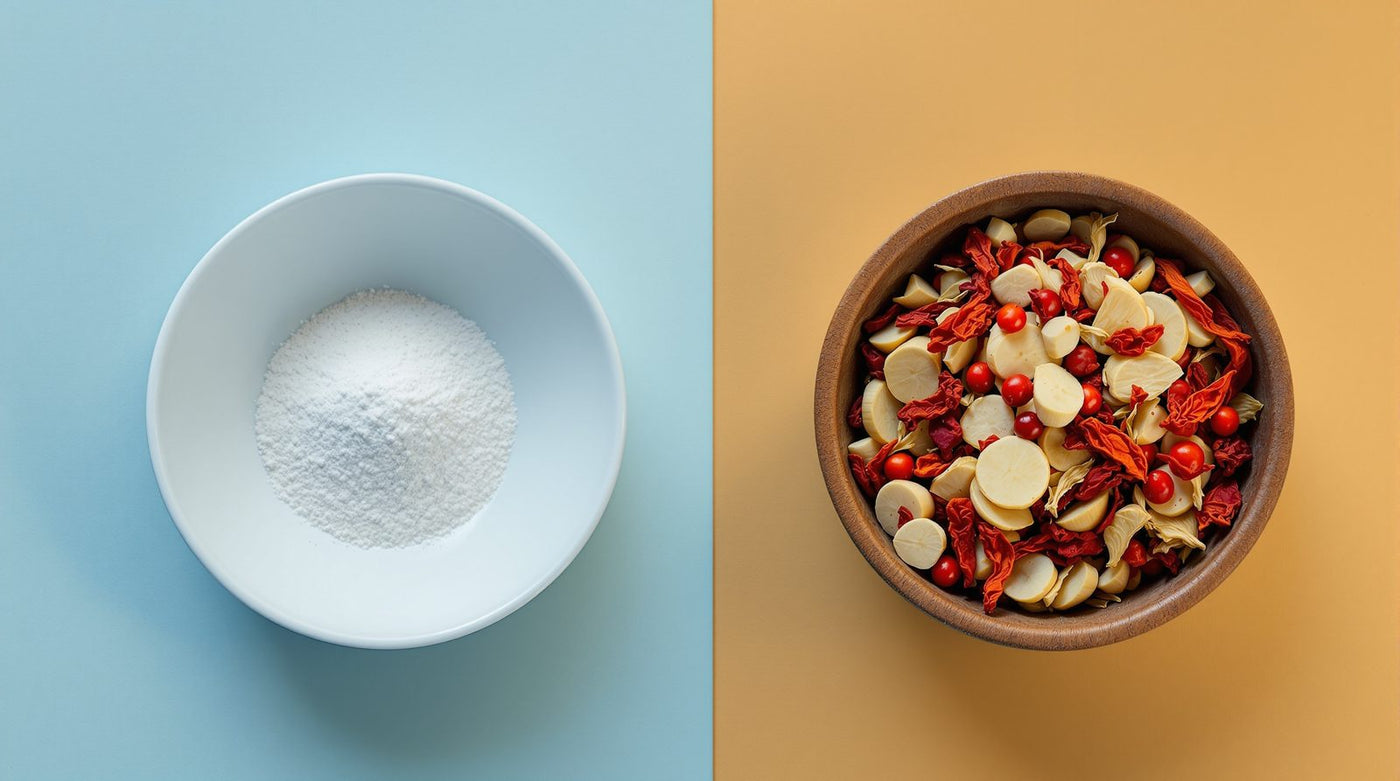
CoQ10, myo-inositol, and DHEA each target a single fertility mechanism. CoQ10 supports mitochondrial energy in egg cells. Myo-inositol helps maintain insulin sensitivity and FSH signaling, with the strongest evidence for PCOS. DHEA plays a role in adrenal androgen balance, with use largely limited to IVF poor responders. TCM fertility herbs work differently. Rather than addressing one biomarker, they support the whole reproductive pattern: circulation to the uterus and ovaries, hormonal axis balance, the body's stress response, immune function at the uterine level, and the constitutional reserves that sustain follicle development over time. A 2011 meta-analysis of 40 randomized controlled trials involving 4,247 women found that Chinese herbal medicine achieved twice the clinical pregnancy rate of Western pharmaceutical therapy over three to six months (Ried & Stuart, Complementary Therapies in Medicine, 2011).
- What Are CoQ10, Inositol, and DHEA?
- How Do TCM Herbs Approach Fertility?
- What Does the Research Show for Each?
- Which TCM Herbs Are in a Fertility Formulation?
- How Is Each Approach Matched to the Individual?
- Can TCM Herbs and Isolated Supplements Be Taken Together?
- Who Benefits Most from Each Approach?
- Frequently Asked Questions
What Are CoQ10, Inositol, and DHEA — and How Do They Work?
CoQ10, myo-inositol, and DHEA are isolated compounds that each address one specific biological mechanism relevant to fertility. They are not herbs and they are not matched to individual reproductive patterns. Each was studied for a specific fertility context: CoQ10 for mitochondrial support, inositol for PCOS insulin signaling, and DHEA for IVF poor responders.
CoQ10
Coenzyme Q10 (CoQ10) is a fat-soluble compound produced by every cell in the body. Its primary role is in the mitochondrial electron transport chain, where it helps generate ATP, the cell's main energy currency. Egg cells require enormous amounts of ATP for the process of meiosis, fertilization, and early embryo division. As women age, cellular CoQ10 levels decline, which some researchers have linked to reduced egg cell energy capacity.
Some studies have found that CoQ10 supplementation may support ovarian response in women who respond poorly to IVF stimulation. A Cochrane systematic review published by Showell and colleagues found that while antioxidant supplementation showed some signal for fertility outcomes, the overall certainty of evidence remains low for general female infertility (Cochrane Library).
Myo-Inositol
Myo-inositol is a carbocyclic sugar that acts as a second messenger in insulin signaling and plays a role in FSH receptor activity within the ovary. Its fertility evidence base is strongest for PCOS. Multiple randomized controlled trials have demonstrated that myo-inositol supplementation in women with PCOS restores ovulation, reduces elevated androgens, and improves insulin sensitivity. Outside of PCOS, evidence for inositol as a general fertility supplement is substantially thinner.
The specificity matters: inositol addresses the insulin signaling pathway. It does not address uterine blood flow, stress hormones, immune function at the endometrial level, or the upstream hormonal axis dysregulation that can disrupt ovulation in women without PCOS.
DHEA
Dehydroepiandrosterone (DHEA) is an adrenal androgen that serves as a precursor to both estrogen and testosterone. Some IVF clinics have used DHEA supplementation for "poor responders" to stimulate ovarian activity before a retrieval cycle. A Cochrane systematic review found insufficient evidence to support routine DHEA use for improving live birth rates, and noted that existing studies carry significant methodological limitations (Cochrane Library). DHEA is contraindicated for women with PCOS, where androgens are already elevated.

How Do TCM Herbs Approach Fertility Differently?
TCM fertility herbs do not target one biomarker. They address the whole reproductive pattern: the relationship between blood circulation, hormonal axis regulation, stress response, immune function at the uterine level, and the deep constitutional reserves that sustain follicle development over time. Two women with the same fertility diagnosis may receive different herb combinations based on their individual pattern.
Symptoms are branches. Beneath them sits a pattern of Qi, Blood, Yin, and Yang that produces what you see. TCM works at that level, which is why several branches often shift together.
In Traditional Chinese Medicine, fertility is assessed through a pattern rather than a single diagnosis. A practitioner observes cycle length and regularity, the quality and timing of cervical mucus, basal body temperature patterns throughout the cycle, energy levels, sleep quality, and specific physical signs. These observations map onto patterns that correspond to measurable reproductive markers: what TCM identifies as kidney yin deficiency overlaps with signs of poor follicular development and low estrogen. What TCM identifies as blood stagnation corresponds with reduced uterine blood flow and elevated inflammatory markers.
The herbs selected are not random. Each herb in a TCM fertility formulation addresses one or more aspects of the pattern: some herbs support circulation to the uterus and ovaries, others nourish the hormonal reserves that sustain follicle development, others modulate the immune environment in the uterus so it can receive an embryo, and others support the body's stress response to reduce the cortisol-driven hormonal disruption that can suppress ovulation.
TCM practitioners have observed for centuries that specific herb combinations support cycle regularity within two to three months. Modern research identifies mechanisms that align with these observations: modulation of the hypothalamic pituitary ovarian axis, measurable effects on FSH and LH pulsatility, improvements in endometrial blood flow, and antioxidant protection of developing follicles.
What Does the Research Show for Each Approach?
TCM as a whole-system approach has the strongest evidence base for fertility outcomes across diverse populations, supported by a meta-analysis of 40 RCTs. CoQ10 shows promise specifically for IVF poor responders and women 35 and older. Myo-inositol has strong evidence for PCOS but limited evidence outside that diagnosis. DHEA lacks sufficient evidence for routine use in improving live birth rates.
| Supplement | Primary Mechanism | Evidence Strongest For | Key Limitation |
|---|---|---|---|
| CoQ10 | Mitochondrial ATP production in egg cells | IVF poor responders, women 35+ | Low-certainty evidence for general female infertility (Cochrane); one mechanism only |
| Myo-Inositol | Insulin and FSH receptor signaling | PCOS ovulation restoration | Evidence is thin outside PCOS; does not address circulation, stress, or uterine immune function |
| DHEA | Adrenal androgen precursor for estrogen and testosterone | IVF poor responders (some centers) | Cochrane: insufficient evidence for live birth rates; contraindicated with elevated androgens (PCOS) |
| TCM Formulation | Multisystem pattern support: circulation, hormonal axis, immune function, stress response, follicular reserves | Reproductive wellness across diverse fertility profiles | Requires 90-day minimum; brewed as a tea (earthy, strong); pattern matching requires individual assessment |
The comparison above is not a dismissal of isolated supplements. CoQ10 and myo-inositol have legitimate use cases. The limitation is their specificity: each addresses one biological pathway. A client who has both poor mitochondrial function and reduced uterine blood flow and elevated stress hormones does not have a one-mechanism problem. Taking CoQ10 alone addresses the mitochondrial piece while the other patterns go untouched.
Research on individual TCM herbs confirms mechanisms that align with what clinical practitioners have observed for decades. Studies on Astragalus Membranaceus show antioxidant effects on developing follicles and potential improvement in ovarian response. Studies on Cuscuta Chinensis indicate support for follicular development and luteal phase adequacy. Research on Goji Berry polysaccharides demonstrates protective effects on oocyte quality under oxidative stress. The difference from isolated supplements is that these herbs are used in combination, matched to the individual's pattern, not prescribed generically.

Which TCM Herbs Are in a Fertility Formulation?
The Project: Life female formulation contains 12 clinic grade TCM herbs selected by Dr. Ye based on 40 years of fertility-specific clinical practice. Each herb addresses a specific aspect of reproductive pattern: blood nourishment and circulation, kidney essence, hormonal axis support, uterine receptivity, and stress modulation. None are isolated compounds.
Supports uterine circulation and endometrial development. One of the most researched herbs for cycle regulation and uterine blood flow.
Nourishes kidney yin and the deep hormonal reserves governing follicle development. Clinically used for diminished ovarian reserve.
Demonstrated anti-androgenic properties relevant to PCOS. Supports estrogen and progesterone balance and reduces uterine inflammation.
Increases circulation to the uterus and pelvic organs. Research shows vasodilatory effects supporting endometrial thickness and receptivity.
Adaptogenic. Supports mitochondrial energy production at the cellular level and strengthens nutrient absorption for conception readiness.
Rich in antioxidants that protect egg cells and uterine lining. Calms the nervous system and reduces cortisol-driven hormonal disruption.
Immune modulating and antioxidant. Supports a regulated immune environment in the uterus essential for implantation. Research suggests improved ovarian response in IVF.
Literally "benefit mother" in Chinese. Directly supports uterine blood flow and regulates the menstrual cycle, particularly for delayed or absent periods.
Classically used for threatened miscarriage. Strengthens the conception vessel (Ren Mai) and supports the hormonal environment needed to sustain early pregnancy.
Supports kidney yang, the warm active energy that drives ovulation and progesterone production. Used alongside Teasel Root for recurrent pregnancy loss patterns.
One of the most antioxidant-dense herbs in TCM. Research demonstrates protective effects on oocyte quality and mitochondrial function in egg cells.
Addresses both kidney yin and yang simultaneously. Research indicates support for follicular development, luteal phase adequacy, and progesterone production.
These 12 herbs are not isolated compounds taken in sequence. They work as a formulation: each herb supports the others, and the specific combination is determined by the intake assessment rather than prescribed generically. The formulation that supports a woman with cold pattern and poor ovulation differs from the one matched to a woman with heat signs and thin uterine lining.
For more detail on each herb and its clinical role, see 12 TCM Herbs for Fertility: What Each Herb Does and Why It's Used.
How Is Each Approach Matched to the Individual?
CoQ10, inositol, and DHEA are dosed generically: the same protocol for nearly every client, with minor adjustments for PCOS or IVF context. TCM formulations are matched to the individual's reproductive pattern through a clinical intake process. Dr. Ye's 3-minute assessment evaluates cycle patterns, symptom clusters, and fertility history to determine which formulation matches the individual's specific pattern.
When a client purchases CoQ10 for fertility, she typically takes the same 600mg dose as every other woman using it. There is no intake. There is no assessment of her cycle length, temperature patterns, or whether her specific fertility challenge involves mitochondrial function at all. The same applies to DHEA: patients receiving it from IVF clinics generally receive the same protocol regardless of whether their androgen levels are already elevated or normal.
The TCM intake is different by design. Dr. Ye's 40 years of clinical practice identified specific patterns that respond to specific herb combinations. The 3-minute assessment evaluates the signals that distinguish one pattern from another: cycle regularity, timing of ovulation, luteal phase length, presence or absence of PMS symptoms, circulation to the extremities, sleep quality, and energy levels across different phases of the cycle. These signals correspond to the hormonal markers Western reproductive medicine tracks: FSH, LH, estrogen, progesterone, and AMH.
The result is a formulation matched to the pattern. Not a generic supplement protocol, but 12 herbs selected because they address the specific layers of imbalance that the intake identified.

Can TCM Herbs and Isolated Supplements Be Taken Together?
TCM herbs and isolated supplements like CoQ10 or myo-inositol generally work through different biological pathways and can often be used alongside each other. Many clients arrive at Project: Life already taking CoQ10 or inositol and continue both. Always discuss any supplement combination with your healthcare provider before starting.
Many clients who find Project: Life have already been taking CoQ10, myo-inositol, or both for months, prescribed by their reproductive endocrinologist or fertility naturopath. They typically continue both while starting their TCM formulation. The mechanisms do not overlap in a way that creates known interactions: CoQ10 supports mitochondrial ATP production while the TCM herbs address the broader pattern of circulation, hormonal balance, and uterine receptivity.
The question worth asking is not "can I combine these?" but "what are the gaps my current protocol is not addressing?" If a client is taking CoQ10 for mitochondrial support but has poor uterine blood flow, a thin endometrial lining, and significant pre-menstrual symptoms that suggest a progesterone pattern — CoQ10 alone will not touch those issues. The TCM formulation addresses the layers that isolated supplements cannot reach because they were designed to address a single pathway, not a whole pattern.
This content is for informational purposes only. Discuss all supplement changes with your fertility care provider before making them.
Who Benefits Most from Each Approach?
CoQ10 is best supported by evidence for women 35 and older and IVF poor responders where mitochondrial energy in egg cells is a primary concern. Myo-inositol has the strongest case for PCOS specifically. TCM fertility herbs address reproductive wellness across a wider range of profiles because the approach matches to the individual pattern rather than a single diagnosis.
Women most likely to see benefit from CoQ10 include those over 35 undergoing IVF, those with a history of poor ovarian response, and those with embryo quality challenges where mitochondrial function in egg cells is a central concern. The evidence base is narrow but the mechanism is credible for this population.
Women most likely to benefit from myo-inositol are those with confirmed PCOS, elevated LH:FSH ratios, or insulin resistance as a driver of anovulation. Outside of PCOS, the case for inositol weakens considerably because the primary mechanism — insulin and FSH signaling — may not be the relevant pathway.
TCM fertility herbs are matched to the individual pattern, which means the entry criteria is different. Rather than a specific diagnosis, the relevant question is: does the intake reveal a recognizable pattern that corresponds to one of Dr. Ye's formulations? In practice, this includes women with irregular cycles, poor ovulation, diminished ovarian reserve, recurrent pregnancy loss, unexplained infertility, endometriosis, and PCOS — because all of these conditions, while distinct in Western terms, can be read through the lens of TCM patterns and addressed with the corresponding formulation.
For clients who have been taking isolated supplements for months without meaningful change, the question is whether the problem exists at the level the supplements are addressing. If not, adding the same supplement at a higher dose will not close the gap.
For a deeper comparison of how TCM and Western reproductive medicine approach fertility differently, see How TCM Approaches Fertility Differently Than Western Medicine.